
Agentic AI in Payments Isn't Just Another Innovation Layer
AI agents are no longer simply assisting consumers. They're increasingly executing payments autonomously on their behalf. Not hypothetically. In present tense. That changes the architecture of payments itself — and forces a deeper question about whether infrastructure can support that level of machine autonomy safely.
I attended a session this week where agentic AI in payments was being discussed. At one point, the presenter described how AI agents may no longer simply assist consumers, but increasingly execute payments autonomously on their behalf. Not hypothetically. Not conceptually. In present tense.
There was a brief pause in the room. A few exchanged glances. The person sitting next to me leaned over quietly and said, "scary stuff." And honestly, I understood the reaction immediately. It felt oddly familiar — almost like those pharmaceutical commercials where, alongside the promised benefits of speed, optimization, convenience, and autonomy, you suddenly hear the disclaimer: "this may cause…" In this case, fraud, compromised agents, malicious orchestration, autonomous exploitation, trust erosion, and entirely new categories of operational risk. Even the idea of "rogue" agents interfering with otherwise trusted systems starts sounding less theoretical than it once did.
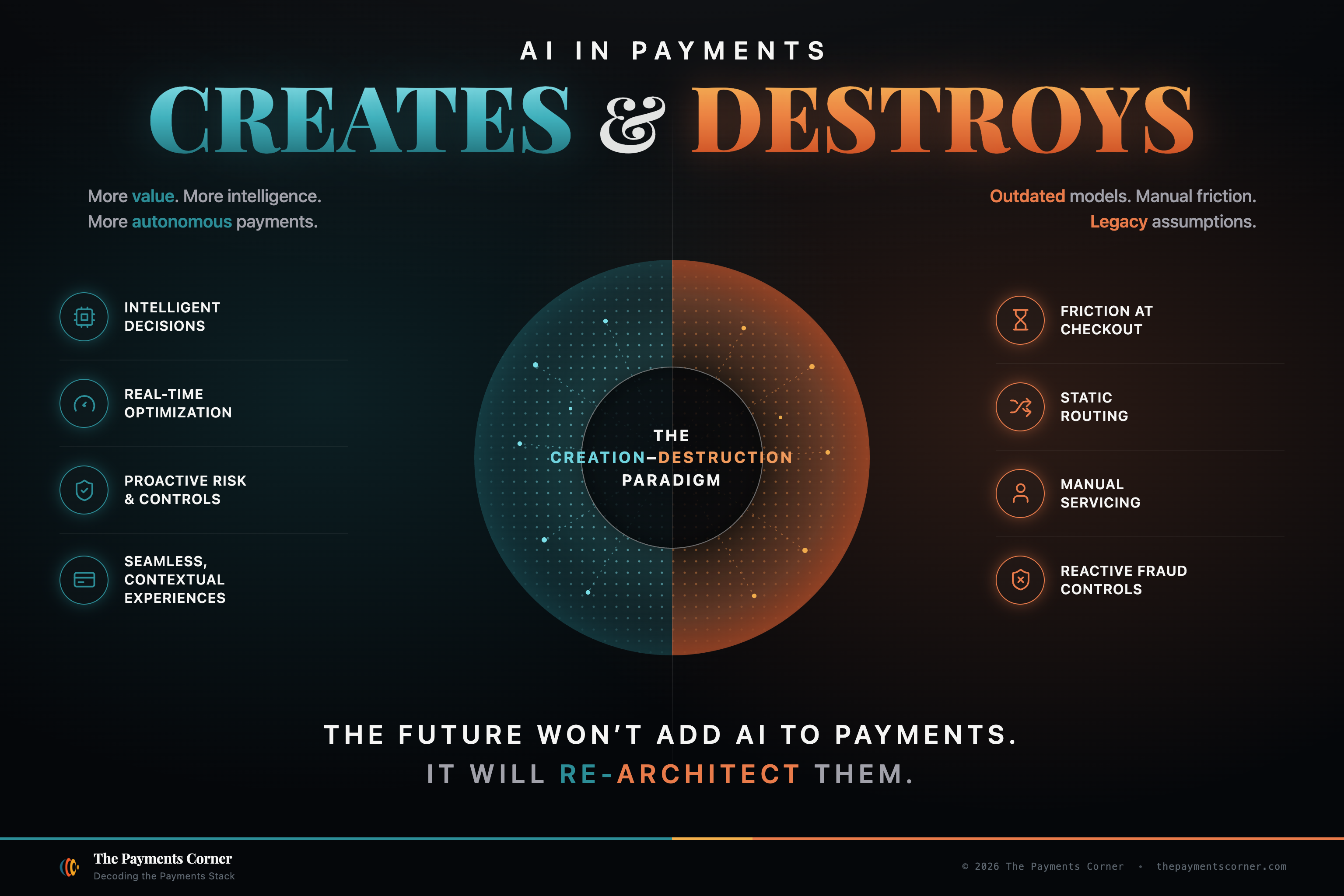
That realization matters because we often frame AI in payments as simply another layer of innovation. But what increasingly appears to be happening is something deeper. A creation-destruction dynamic.
Agentic AI will almost certainly create enormous value. Payments may become more contextual, more predictive, more autonomous, more optimized, and increasingly embedded into decision-making flows. AI systems may not merely recommend payment methods, rails, timing, or credit structures. They may increasingly select the rail, optimize liquidity usage, apply controls dynamically, manage transaction timing, evaluate fraud exposure, orchestrate servicing logic, and execute transactions directly against user intent. That changes the architecture of payments itself.
At the same time, portions of the existing ecosystem may begin eroding. Traditional friction points may weaken — manual checkout flows, static routing logic, reactive fraud controls, human servicing interactions, and even some loyalty mechanics tied to explicit user decision-making. That is where the real structural shift begins. Because this is not simply about inserting AI into existing payment flows. It is about whether the underlying infrastructure is capable of supporting a fundamentally new level of machine autonomy safely and reliably.
In other words — can the infrastructure itself authorize dynamically, orchestrate risk, enforce controls, manage delegated authority, monitor agent behavior, and operate safely within clearly defined governance boundaries? That is no longer purely a UX question. It becomes a processing, governance, and trust architecture question. And in payments, trust has always been foundational. Autonomy without trust does not scale. Without trust, the system itself fractures.
That may ultimately become the defining challenge of agentic AI in financial services. Not whether autonomous systems can technically execute payments. But whether the ecosystem can establish governance, accountability, security, liability structures, and operational trust strong enough to support that autonomy safely at scale.
Which leads to a more personal question that may reveal how early we still are in this transition. Have you already given your AI assistant your card number, expiration date, and CVV, and allowed it to transact autonomously on your behalf? If not, why not? The answer to that question may tell us far more about the current state of trust in agentic payments than the technology itself.
Autonomy without trust doesn't scale. Without trust, the ecosystem breaks.
Franco Di Pietro
The Payments Corner
30+ years across payments, fintech, banking, and financial infrastructure. Operator-level perspectives on the systems that move money.
Related Insights
Citi's card-linked offer acquisition bets on cost, not on proven category economics
Citi's acquisition of Kard Financial rests on operational and financial logic—lower rewards spend, faster platform build—but the card-linked offer category itself has never demonstrated standalone profitability. Cardlytics, the only pure-play, has burned $1.15bn cumulatively since its 2018 IPO and generated negative shareholder equity last year.
The PayPal Valuation Paradox
Stripe and Advent walked away, PayPal lost nearly 13% in a day, and the takeover premium disappeared. The failed deal exposed a more important question: how much value is the public market actually assigning to Venmo?
Kraken's card is a bet on controlling the funding decision, not the transaction
Kraken's debit card—with its 2% rewards across multiple asset balances—is not a payments product disguised as one. It is a wallet-stickiness play that inverts traditional card architecture: instead of a card accessing a single account, the platform now decides which of many balances funds each purchase, moving the locus of control from the network to the issuer's financial operating system.