
Transaction Velocity, Not a Consumer-Credit Boom
Wall Street's blowout quarter was about money moving — not consumers borrowing more. Spending is up; borrowing is flat. That decoupling is where the next few years of lending and payments strategy get decided.
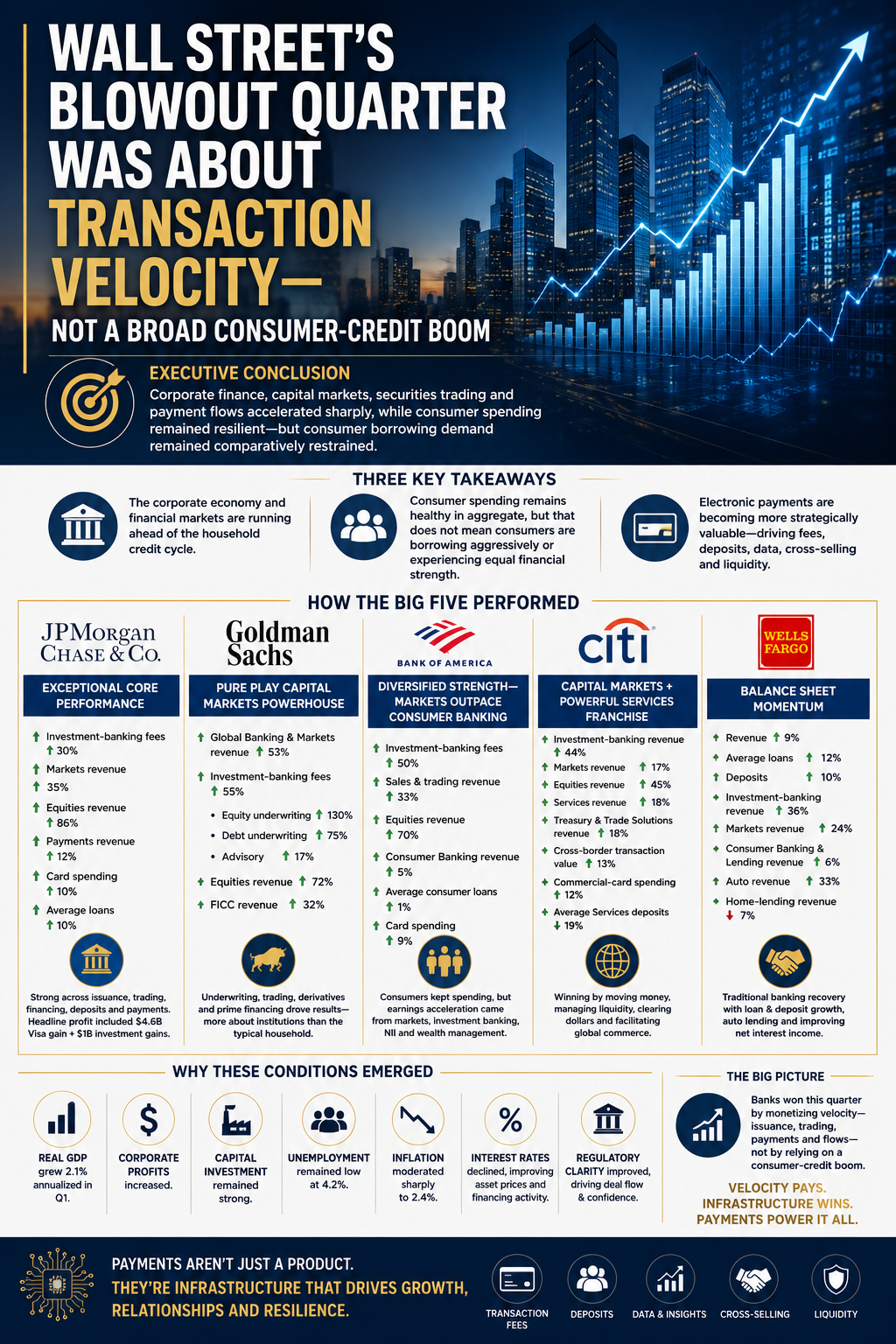
Wall Street had a blowout quarter because money was moving — not because consumers were borrowing more. Those are different economies, and the gap between them is the story.
Five banks earned roughly $49 billion in a single quarter, and the headlines read it as a strong economy. The prints said something narrower. The acceleration came from underwriting, trading, dealmaking, and payment flows — transaction velocity — not from households taking on debt. Goldman's banking and markets revenue rose 53%. JPMorgan's equities rose 86%. Strip out the movement of institutional money and the consumer chapter is quieter: spending resilient, borrowing flat.
That decoupling is the signal worth holding onto. Card spend rose roughly 10% across the majors — JPMorgan up 10%, Citi's U.S. cards up 11%, Bank of America's combined spend up 9%. Yet Federal Reserve data show revolving credit *contracting*, at a 4.7% annualized rate in May, with loan demand softening across cards and autos. Consumers are still transacting. They are not levering up to do it. Payment volume and credit appetite have come apart.
Two consequences follow. For consumer lending, the era of broad balance-sheet expansion is not back — precision is. Banks are competing hard for prime and affluent cardholders, growing lines selectively, and increasingly underwriting on transaction and deposit behavior rather than bureau scores alone. The consumer economy is a barbell, and it is being financed like one.
For payments, interchange is no longer the point. The transaction flow is valuable for the deposit it parks, the data it generates, the treasury relationship it anchors, and the lending it eventually cross-sells. Citi's Treasury and Trade Solutions revenue rose 18% — that is the tell. Whoever holds the payment credential increasingly holds everything downstream of it.
The banks did not report that everyone is doing well. They reported that money moved — and that the institutions positioned where it moved got paid. The question the next few years will answer is who owns the flow when spending and borrowing have stopped moving together.
#Banking #ConsumerCredit #Payments #IssuingRisk #Fintech
Franco Di Pietro
The Payments Corner
30+ years across payments, fintech, banking, and financial infrastructure. Operator-level perspectives on the systems that move money.
Related Insights
Citi's card-linked offer acquisition bets on cost, not on proven category economics
Citi's acquisition of Kard Financial rests on operational and financial logic—lower rewards spend, faster platform build—but the card-linked offer category itself has never demonstrated standalone profitability. Cardlytics, the only pure-play, has burned $1.15bn cumulatively since its 2018 IPO and generated negative shareholder equity last year.
The PayPal Valuation Paradox
Stripe and Advent walked away, PayPal lost nearly 13% in a day, and the takeover premium disappeared. The failed deal exposed a more important question: how much value is the public market actually assigning to Venmo?
Kraken's card is a bet on controlling the funding decision, not the transaction
Kraken's debit card—with its 2% rewards across multiple asset balances—is not a payments product disguised as one. It is a wallet-stickiness play that inverts traditional card architecture: instead of a card accessing a single account, the platform now decides which of many balances funds each purchase, moving the locus of control from the network to the issuer's financial operating system.